
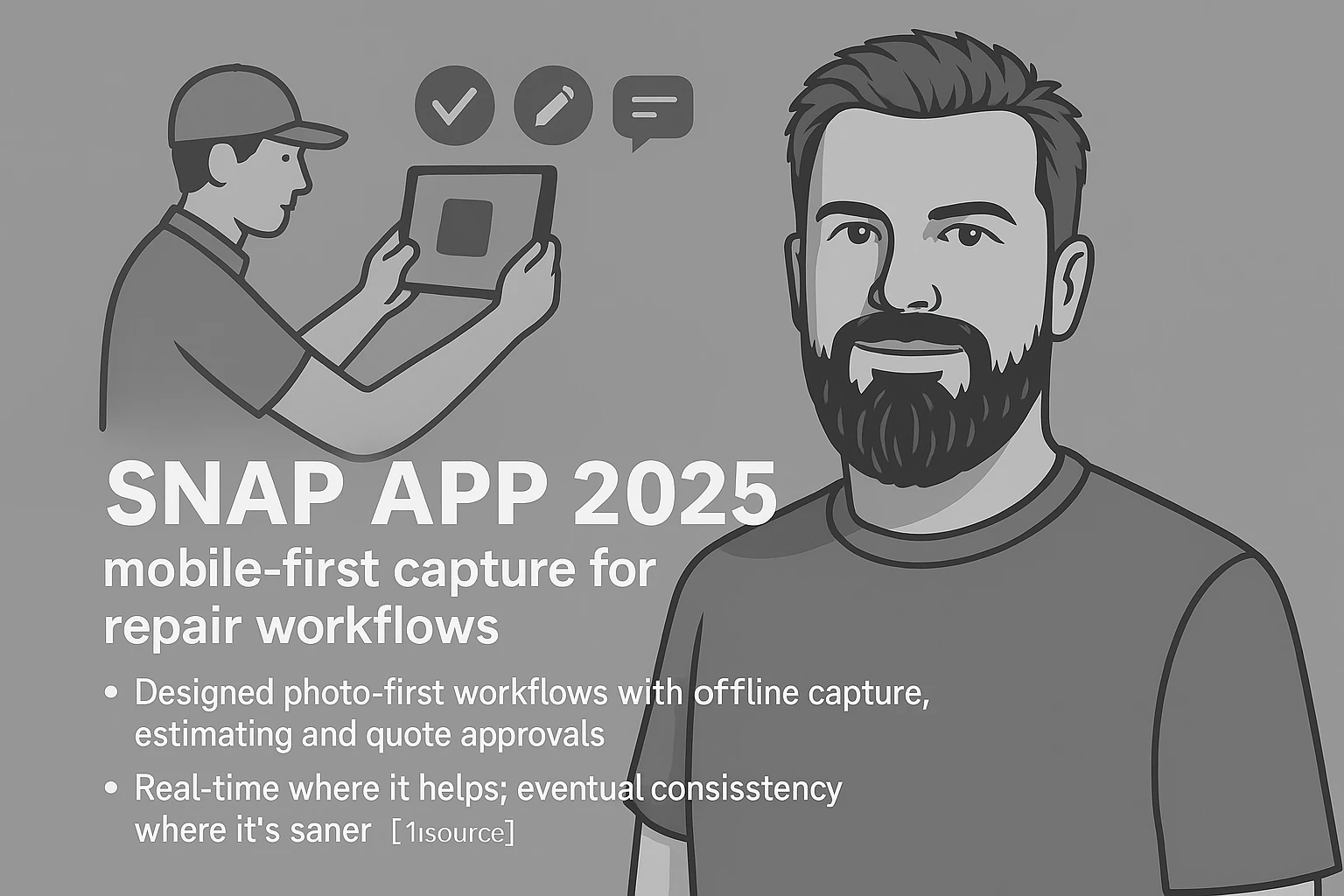
Designed photo-first workflows with offline capture, estimating and quote approvals.
Real-time where it helps; eventual consistency where it’s saner.
When I sketched out the idea for Snap App in early 2025, I didn’t want another “app for forms” in a workshop. I wanted capture, decision, flow. Think: a technician on a repair bay with a tablet or phone, snapping photos as they go, estimating on the spot, getting quote approvals, all without waiting on connectivity or dispatch. That turns the typical “we’ll get back to you” rhythm into “we’re done and off to the next job.”
Why mobile-first matters
The industry is already shifting. Field service and repair workflows are embracing mobile-first strategies because tech has finally caught up with expectation. A recent article noted that mobile‐first tools give technicians real-time access to customer history, repair manuals, and parts inventory — everything they need at their fingertips. fieldservicenews.com+2aiventic+2 In the auto-repair space, a trend piece points to 2025-and-beyond as the era where workflows will revolve around photo, video, and mobile capture rather than paper and desktop terminals. Shop Hero Dashboard
That matters for Snap App because the user isn’t sitting at a desk. The user is in the bay, maybe slightly oily, maybe the signal is weak. So the UX has to anticipate that. Offline capture, photo annotation, voice notes + quotes + approvals — all in one pass. If connectivity fails, the work continues, sync happens later. That’s the “eventual consistency where it’s saner” line.
How it works (code snippet)
Here’s a little pseudo-code showing how we architected the capture → sync flow:
function UseCaptureSession(sessionId) {
const [photos, setPhotos] = useState([]);
const [notes, setNotes] = useState(“”);
const addPhoto = async (file) => {
const localUri = await saveLocally(sessionId, file);
setPhotos(prev => […prev, localUri]);
};
const submitEstimate = async () => {
const record = { sessionId, photos, notes, quote: computeQuote(photos) };
await localDB.put(‘repairSessions’, record);
if (navigator.onLine) {
await syncSession(record);
}
// feedback to user: “Saved locally / Submitted”
};
return { photos, notes, addPhoto, submitEstimate };
}
// On the server side – minimal rendering, mostly indexing:
app.post(‘/api/syncSession’, async (req, res) => {
const { sessionId, photos, notes, quote } = req.body;
await db.save({ sessionId, photos, notes, quote, timestamp: Date.now() });
await indexer.index({ sessionId, keywords: extractKeywords(notes) });
res.json({ success: true, sessionId });
});
Real-world context & why this matters
-
A field service article notes mobile capture and offline capability are now critical for productivity, especially where connectivity is variable. DreamzCMMS+1
-
In repair shops, the future of workflow management is described as leaning heavily on mobile tools, image capture, automation of quotes/parts/customer comms. Shop Hero Dashboard
-
The “mobile-first” design philosophy isn’t just about small screens — it’s about task first, minimal context switching, and working where the work happens (in this case: the bay). The Interaction Design Foundation
For Snap App, what this means is:
-
Photo-first workflow: rather than “tech logs damage → back office estimates”, the tech logs damage and the quote in the same session.
-
Offline support: if the network blips, they still keep working; the app writes to IndexedDB/local DB and syncs later.
-
Integration: estimate → quote approval → job start, tied to the repair centre’s workflow (e.g., parts ordering, time tracking, workshop board).
-
Real-time where it matters: job start notifications, quote approvals, photo reviews; but we avoid real-time burdens where they don’t add value (e.g., “live UI for every click”).
-
Eventual consistency where it’s saner: updates, syncs, indexing happen in the background; the UI remains in the technician’s control.
Looking ahead
By end of 2025 I expect Snap App to support:
-
Multi-tech sessions: multiple technicians capturing in the same job, syncing later, conflict-resolution built in
-
AI-assisted photo tagging: recognise damage hotspots, suggest parts or labour hours
-
Semantic search across sessions: “show me all jobs with bumper scratch + ARB bull bar”
-
Deeper ERP integration: job starts trigger stock reservations, finance capture flows directly into the broader system (e.g., Dynamics 365 BC).
Final thought
If you’re building software for the real world (not the showroom), then the phone or tablet is your primary interface. The network and servers are helpers — critical, but in the background. Snap App is a commitment to that principle: build capture, estimate, approve, and sync in the field. Because when the technician can go from damage → quote → repair in one uninterrupted flow, that’s when you remove friction and add value.