
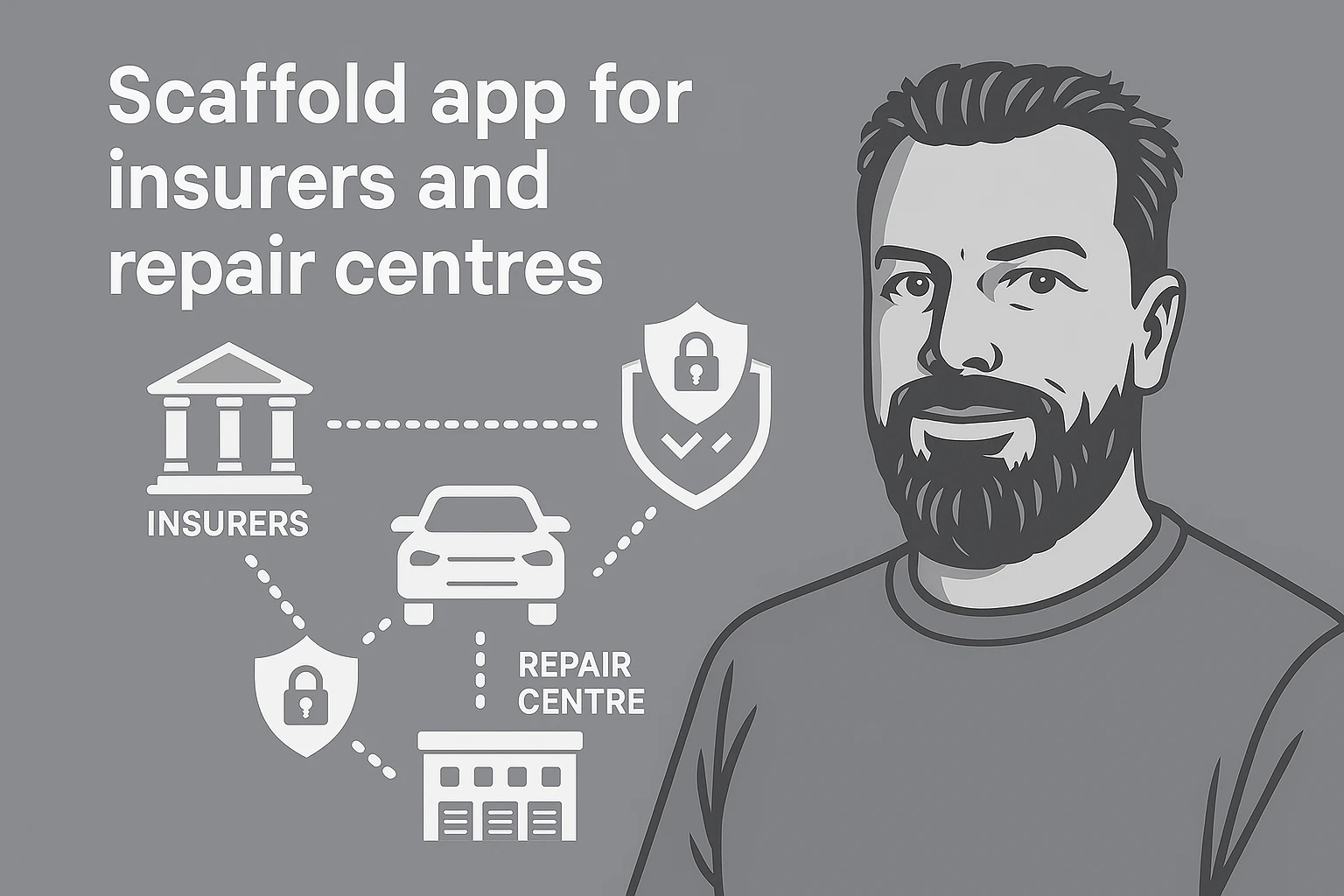
Blueprinted a network where insurers submit vehicles and repair centres manage quotes, docs and progress.
Privacy by design: each party sees only their jobs; central authority oversees the network.
I sketched this concept because I kept seeing a gap: insurers, repair centres, vendors—all part of the same process but forced into disconnected tools and paper workflows. So the idea became: build a scaffold app (think: “infrastructure as soft-middleware”) that lets insurers drop in a vehicle job, repair centres pick it up, quote, document, update status—and do all that with minimal friction, strong privacy and efficient data flows.
Why this matters now
The insurance industry is racing to modernize. According to McKinsey & Company, property & casualty insurers face ageing core systems and rising demands for real-time responsiveness and ecosystem integration. McKinsey & Company
Likewise, repair chains and workshops are looking to streamline dwell times, reduce manual hand-offs, and improve transparency. There are emerging case-studies around networks delivering claims + repair + parts orchestration. For example, a recent piece mentions how insurers and repair facilities are leveraging advanced networks, blockchain and AI to deliver more efficient end-to-end workflows. Toolify
The scaffold app sits exactly at this intersection: build the network layer, not just the endpoint.
Architecture thoughts
-
Submission layer (Insurer): job submission including vehicle details, damage photos, initial estimate triggers.
-
Assignment & document layer (Repair centre): repair centre views only the jobs assigned to them, uploads quotes, attaches documents, updates status.
-
Orchestration & privacy layer: The central authority (you) runs the service, ensures each party only touches their portion, and maintains audit logs, encryption, conflict resolution, and P2P sync where relevant.
-
Sync and offline capability: Because repair bays might be in low-connectivity zones (or mobile onsite), the app must allow local edits, offline capture, later sync.
-
APIs and integrations: Link to ERPs (e.g., parts ordering), insurance claim systems, repair-shop tools.
Here’s a simplified pseudo-code snippet showing how you might orchestrate job visibility and privacy:
POST /api/jobs
{ insurerId, vehicleId, photos, initialNotes }
→ returns jobId
PATCH /api/jobs/{jobId}/assign
{ repairCentreId }
GET /api/jobs?assignedTo=me
→ returns only jobs where assignedTo = currentRepairCentre
function syncJobUpdates(jobUpdate) {
// save update
db.jobs.update(jobUpdate.jobId, jobUpdate)
// notify insurer or repair centre as per role
notifyParty(jobUpdate.relatedPartyId, jobUpdate)
}
Real-world context & lessons
-
Many insurers today are embracing ecosystem connectivity instead of monolithic solutions. McKinsey notes carriers must shift from legacy core systems toward modular platforms that allow integration with partners. McKinsey & Company
-
Claims operations at scale are being modernized: a major P&C insurer reduced manual claims handling and improved partner workflows by redesigning the network of service providers. Insurance Journal
-
Networks matter. In the DACH region, 13 insurers formed a “learning & transformation network” to share digital-workflow improvements. goodhabitz.com
These reinforce that your scaffold app is built not just for one repair shop but for a networked ecosystem.
Key design principles
-
Least privilege: repair centres see only their jobs; insurers see only what matters to them. Central log tracks all.
-
Immutable logs + auditability: each quote, document, status change should be signed or timestamped (blockchain or DLT could be used when audit matters).
-
Offline resilience: field workers at repair centres may lose signal; local DB + P2P sync = better UX.
-
Seamless hand-offs: insurer submits → repair centre quotes → repair begins → insurer approves → job wraps up. Each hand-off is smooth, transparent.
-
Flexibility and extensibility: The scaffold isn’t just for vehicles; same pattern could apply for other repair workflows, service networks, third-party vendors.
Looking ahead
In 2026 I expect this scaffold app to evolve:
-
Semantic search across jobs: “show me all jobs for my insurer in the past 12 months with chassis damage >$5k”
-
AI-suggested bids and quoting: using past data to propose standard rates or parts lists
-
Peer-to-peer sync across multiple repair centres: for large insurer networks where jobs hop between sites
-
Embedded insurance / repair finance flows: quoting, approval and payment logic in one line of sight
-
Graph data modelling for network mapping: insurer → repair centre → parts supplier → payment authority, all nodes in a network you can query.
Final thought
If you build for networks, not just apps, you unlock compounding value. The scaffold app for insurers and repair centres is a network instrument — and when you get the orchestration, privacy, and resilience right, you turn a process-chain into a platform. That’s the space I’m playing in and the space I believe the next generation of repair/claim systems will occupy.