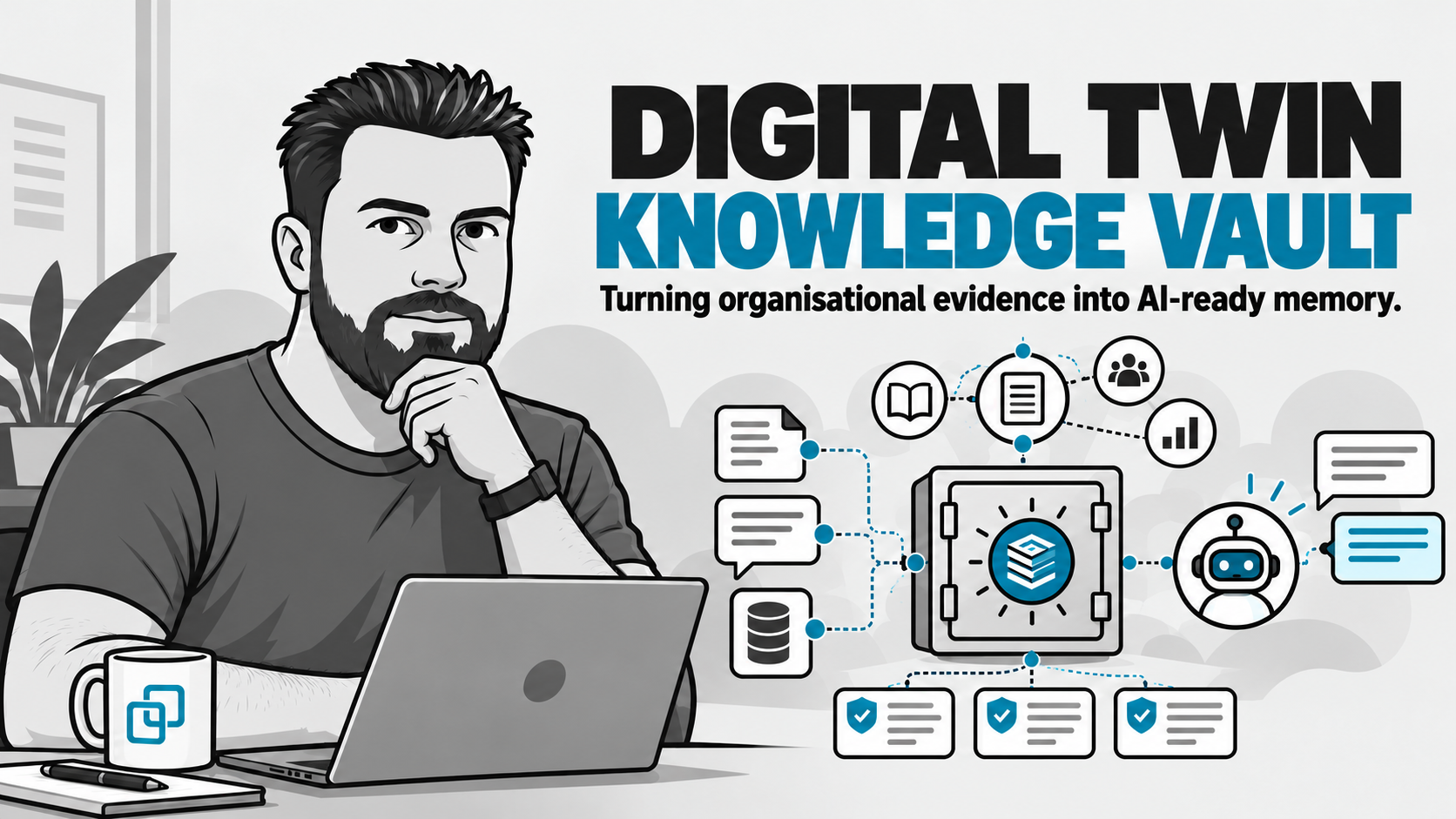
Most organisations have a memory problem. Important knowledge sits across documents, meeting notes, chat conversations, email, systems and the minds of employees. AI can search that information, but too often it has to reconstruct the same understanding every time somebody asks a question.
I have been developing an alternative: a Digital Twin Knowledge Vault — a maintained, evidence-linked organisational memory that people and AI agents can work with together.
Not another folder full of documents
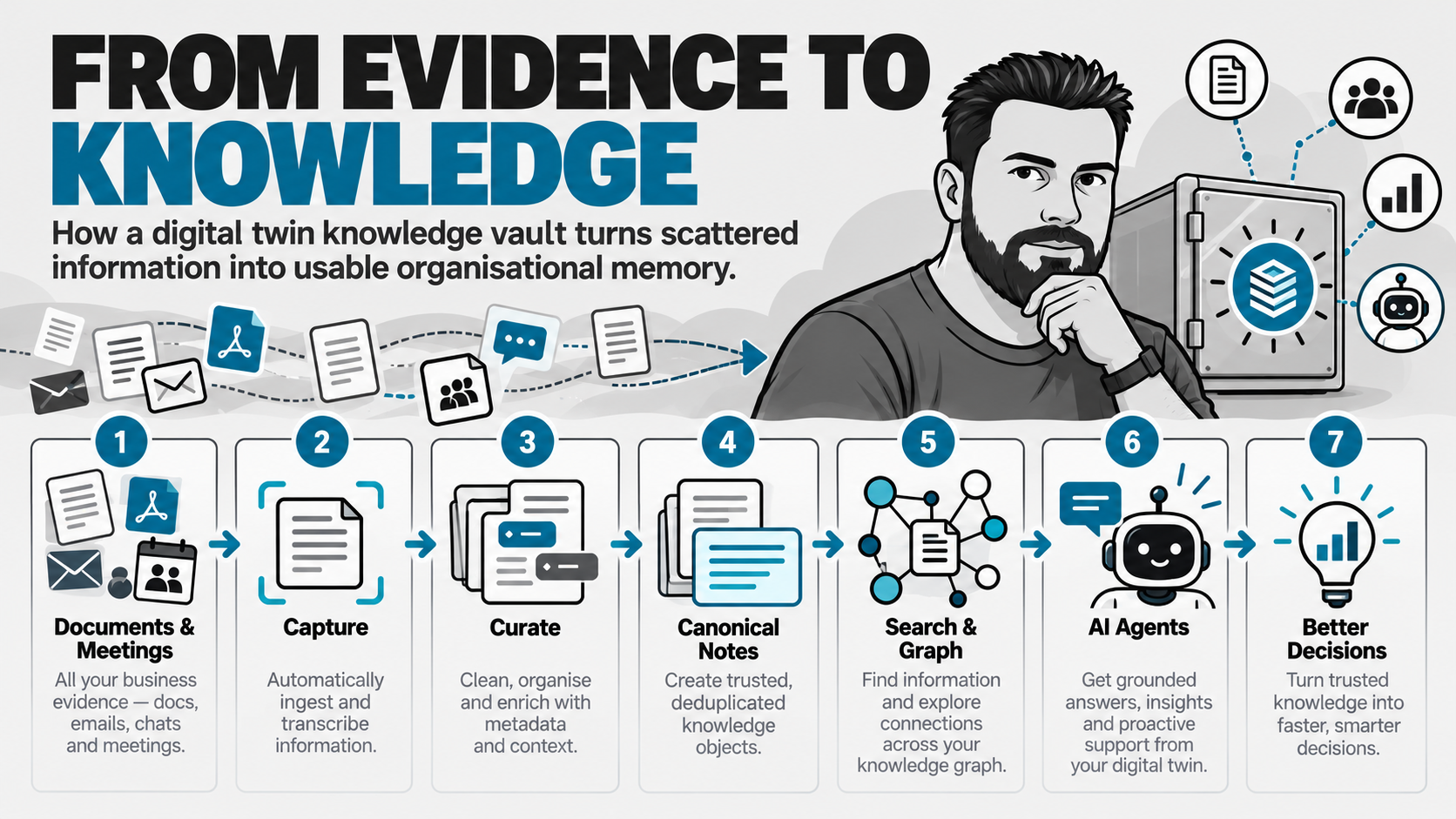
The point is not to store every conversation or generate thousands of AI summaries. It is to turn useful evidence into durable, connected knowledge. A project, system, stakeholder, decision or concept should have a canonical home, updated when new information arrives rather than duplicated in another note.
My working principle is simple: preserve the evidence, curate the understanding, connect the relationships, and record every accepted change.
The foundation: Markdown and Git
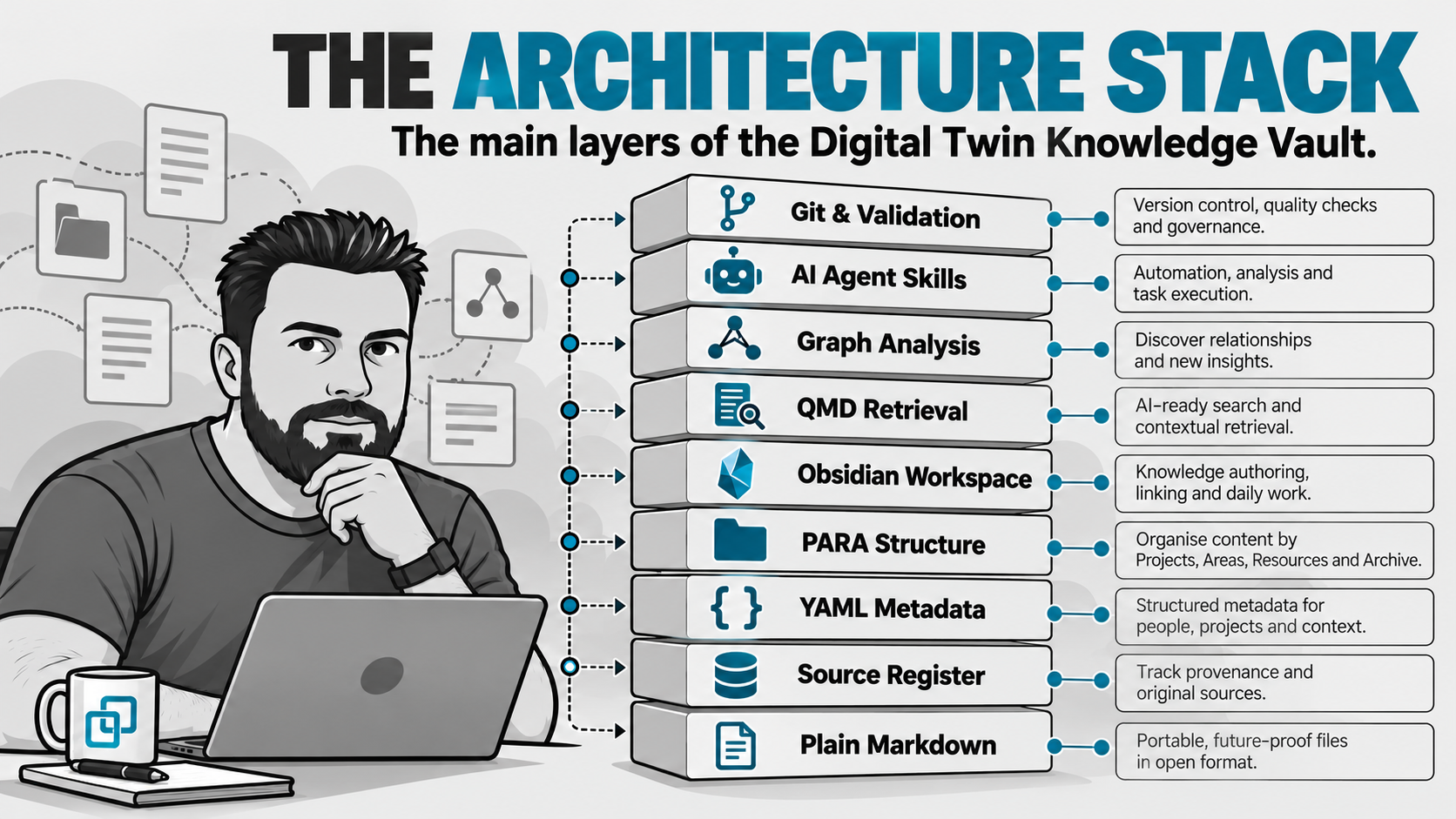
The durable system of record is plain Markdown, accompanied by source references and Git history. That matters because a knowledge base should outlive any particular AI model, search engine or productivity tool.
Obsidian provides a useful human interface through properties, backlinks, graph views, Bases and Canvas. Git makes changes inspectable and reversible. Neither is allowed to turn an AI-generated recollection into an unquestionable fact.
Make knowledge compound
A conventional retrieval-augmented generation (RAG) system commonly retrieves raw document fragments and asks an AI model to synthesise an answer from scratch. The LLM Wiki pattern adds a maintained knowledge layer between sources and answers.
When something meaningful happens, the agent can capture it, inspect the original evidence, search for existing concepts, update or create the appropriate canonical note and connect it to related knowledge. Over time, the organisation builds on previous understanding instead of repeatedly starting again.
Keep the structure understandable
I use the PARA model to organise knowledge by its current purpose: Projects for time-bounded outcomes, Areas for ongoing responsibilities, Resources for reusable concepts, and Archive for inactive history. An Inbox receives rough captures before they are curated.
Structured YAML metadata gives each durable concept a type, description, owner, status, source, confidence and sensitivity where appropriate. The important distinction is between what a human approved, what a source directly supports, what AI inferred and what remains ambiguous.
Use search and graphs without making them the truth
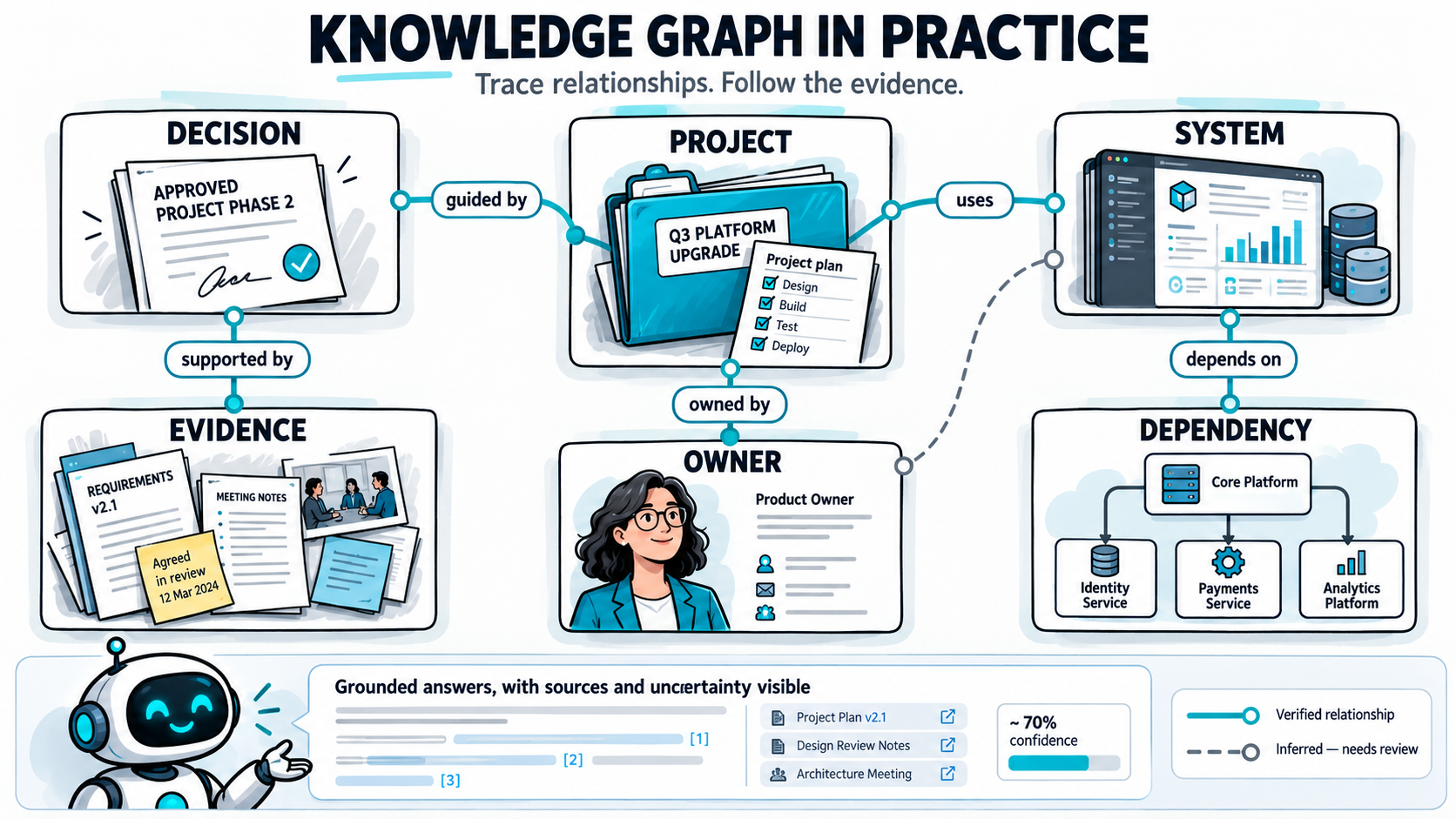
A local retrieval layer such as QMD can combine keyword matching, semantic search and reranking to bring the right context to an agent. A Graphify-style process can help discover dependencies between systems, decisions, teams and strategies.
But embeddings, graph experiments and runtime AI memories are derived layers. They can be rebuilt. The Markdown concepts, supporting evidence and accepted Git history remain authoritative. An inferred relationship should never silently become a verified one just because it looks convincing on a graph.
Give AI useful work, not unlimited authority
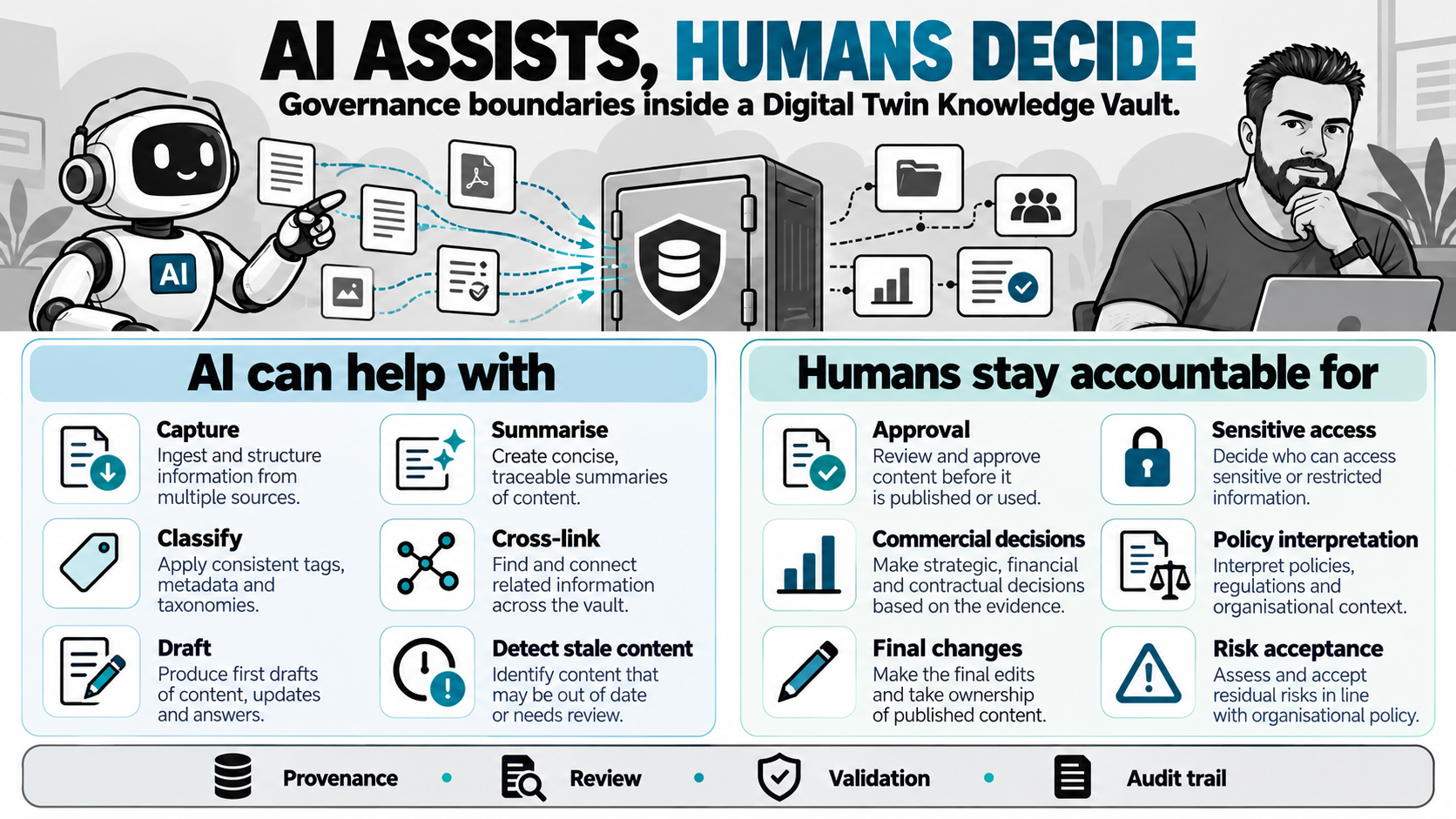
AI can help with the repetitive work: classification, extraction, summarisation, cross-linking, finding duplicates, identifying stale content and preparing decision briefs. People retain authority over consequential decisions.
The design therefore includes sensitivity classifications, explicit AI-access boundaries, source provenance, human review and structural validation. Sending confidential information, changing access, accepting commercial commitments or deleting durable knowledge should not happen merely because an agent thinks it is helpful.
An operating rhythm, not a one-off setup
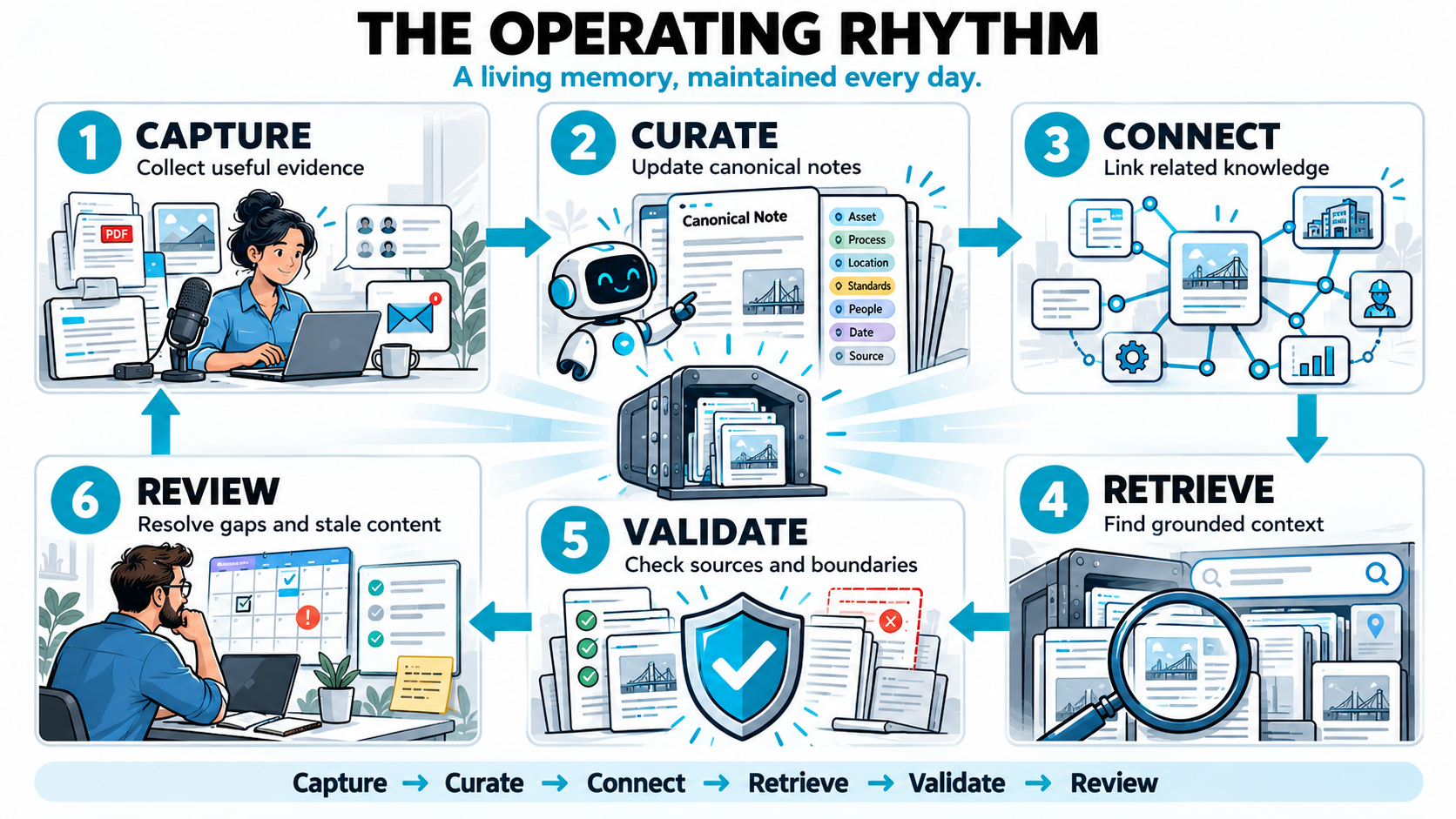
A useful digital twin needs maintenance. I think about the workflow in six verbs: Capture → Curate → Connect → Retrieve → Validate → Review.
During the day, valuable decisions and observations are captured. After meetings, actions and decisions are moved into their canonical homes instead of staying buried in minutes. Weekly reviews look for broken links, duplicates, contradictions, ageing decisions and missing ownership. Git and automated checks help keep that maintenance auditable.
What this makes possible
Imagine asking an agent which projects rely on a particular business system, what decision created that dependency, what evidence supported it and which assumptions may now be outdated. The answer should come from connected, inspectable knowledge — with uncertainty visible — rather than from whichever documents happened to rank highest in a search.
That is what I mean by an organisational digital twin in this context. It is not a live 3D replica of a building. It is a working representation of an organisation's knowledge, relationships, commitments, systems and decisions.
My ambition is an AI-ready workplace where experience accumulates, knowledge survives staff and tool changes, and people can make better decisions with clearer evidence.
The goal is not more notes. It is a memory the organisation can use — and trust.