AI Agents and Trusted Records in Everyday Business
Andrew Bart — 28 October 2026
A personal prediction for the next five to ten years.
The prediction
I believe that within five to ten years, the way we use computers will change substantially. Instead of spending much of our time navigating applications, websites and business systems, we will increasingly communicate naturally with AI agents that coordinate those systems on our behalf.
Computers and software will remain essential. Their work will increasingly happen in the background: observing real-world events, arranging transactions, maintaining records and making sure commitments are fulfilled.
My prediction is that AI agents and interconnected blockchain ledgers will become central to this environment. Agents will organise activity, while shared systems of record preserve an auditable history of what happened, who authorised it and what obligations remain.
A business with a live digital twin
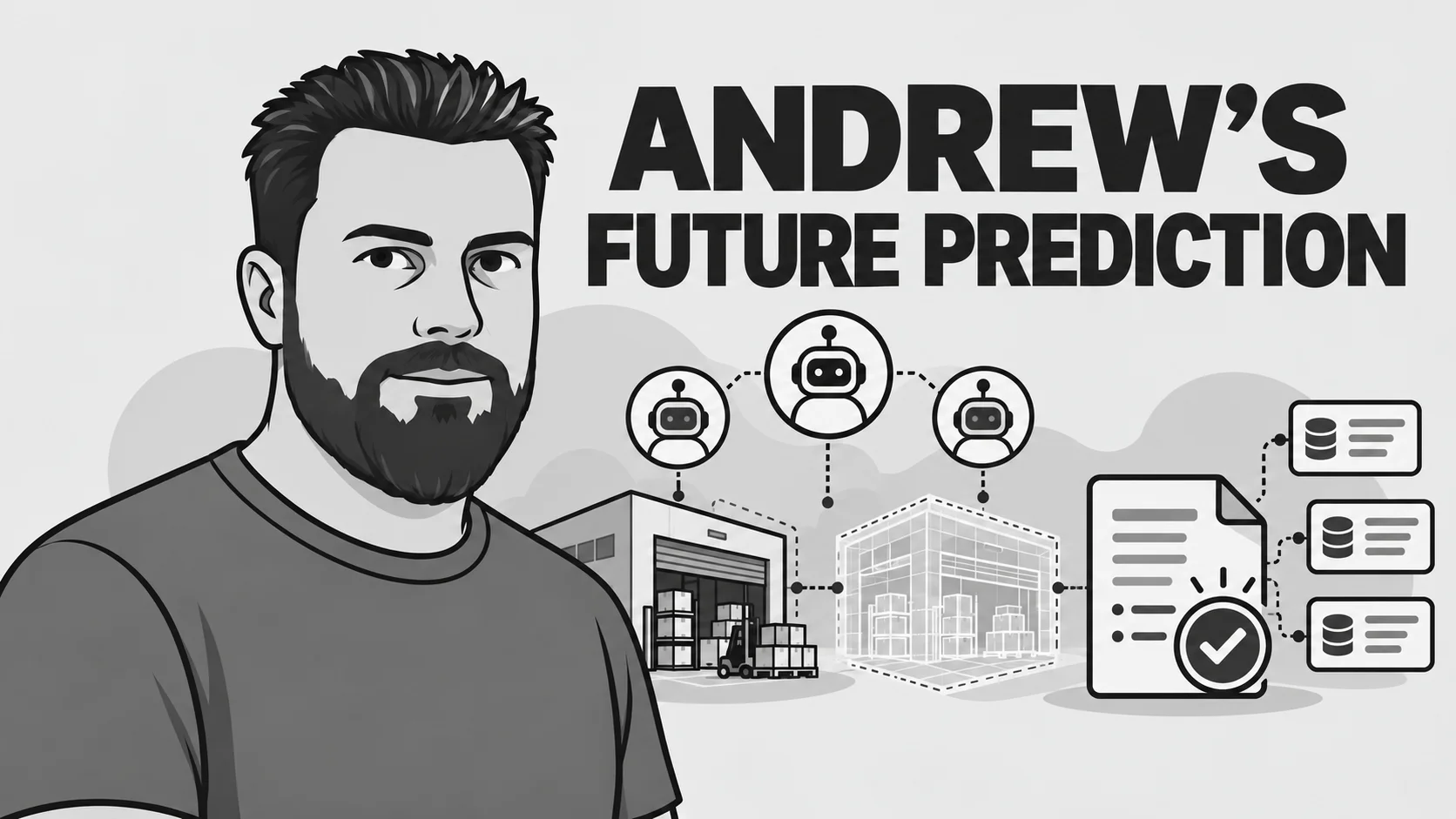
Imagine a hardware supplier such as Dahlsens. Cameras, inventory systems and other sensors feed information into AI that maintains a digital twin of the business.
That twin represents more than the building. It tracks stock, deliveries, customer orders, purchases and outstanding work. A visual environment could make this information understandable, while voice provides another way to interact with it.
A customer could explain what they need to their own agent. That agent could communicate with the supplier’s agent, check availability, arrange collection or delivery and coordinate payment.
Physical activity and digital administration would become closely connected. The business would spend less time manually entering information about events its systems had already observed and confirmed.
Administration follows the transaction
Once a purchase is authorised and confirmed, the surrounding processes could happen automatically: stock changes, payment settlement, receipts, accounting entries and relevant tax calculations.
Where rules and infrastructure permit, reporting and remittance could also be automated. People would no longer need to repeatedly transfer the same information between disconnected systems.
The same principle could extend to services. A record would connect what was promised, what was paid and what was delivered. If something went wrong, the parties could trace the sequence and establish what needed correcting.
Identity and human authority
A person’s agent would need a reliable identity and clearly defined authority.
For a significant transaction, a biometric checkpoint on a phone could confirm the person’s approval. Routine activity could operate within permissions established beforehand, including spending limits and approved suppliers.
The useful record would be evidence of authorisation linked to the transaction. It would not require publishing someone’s face or raw biometric data on a ledger.
People would retain the ability to inspect activity, withdraw permissions and challenge mistakes.
Many connected systems of record
I do not expect one ledger to contain everything. I envisage many interconnected ledgers serving businesses, industries and communities, with agents able to work across them.
For that to succeed, the systems must share more than connectivity. They need compatible identities, permissions and definitions of transactions, ownership and fulfilment.
My central expectation is that people will experience these systems through their agents, without needing to understand every ledger or software platform underneath.
What must be solved
This is a prediction, rather than a claim that the complete system already exists or that its adoption is inevitable.
Cameras can misinterpret events. An immutable record can preserve an incorrect entry. A reliable system must distinguish an observation from a confirmed purchase and provide ways to record corrections and resolve disputes.
Storage and privacy also matter. A practical architecture could keep video and sensitive business information in controlled storage, while recording transaction evidence and cryptographic proofs on shared ledgers.
Better computing power and bandwidth would help, but progress also depends on interoperability, security, governance and public trust.
The intended outcome
My prediction is ultimately about making everyday life work better.
People should spend less time administering transactions and more time doing useful work. Businesses should have clearer information. Customers should receive what they paid for, with evidence and remedies when they do not.
Technology alone will not guarantee fairness. But I believe AI agents, digital twins and trusted records could provide the foundations for systems that are more accountable, easier to use and less burdensome.
Over the next five to ten years, I expect computing to move further into the background—continuously helping people coordinate the real world.